
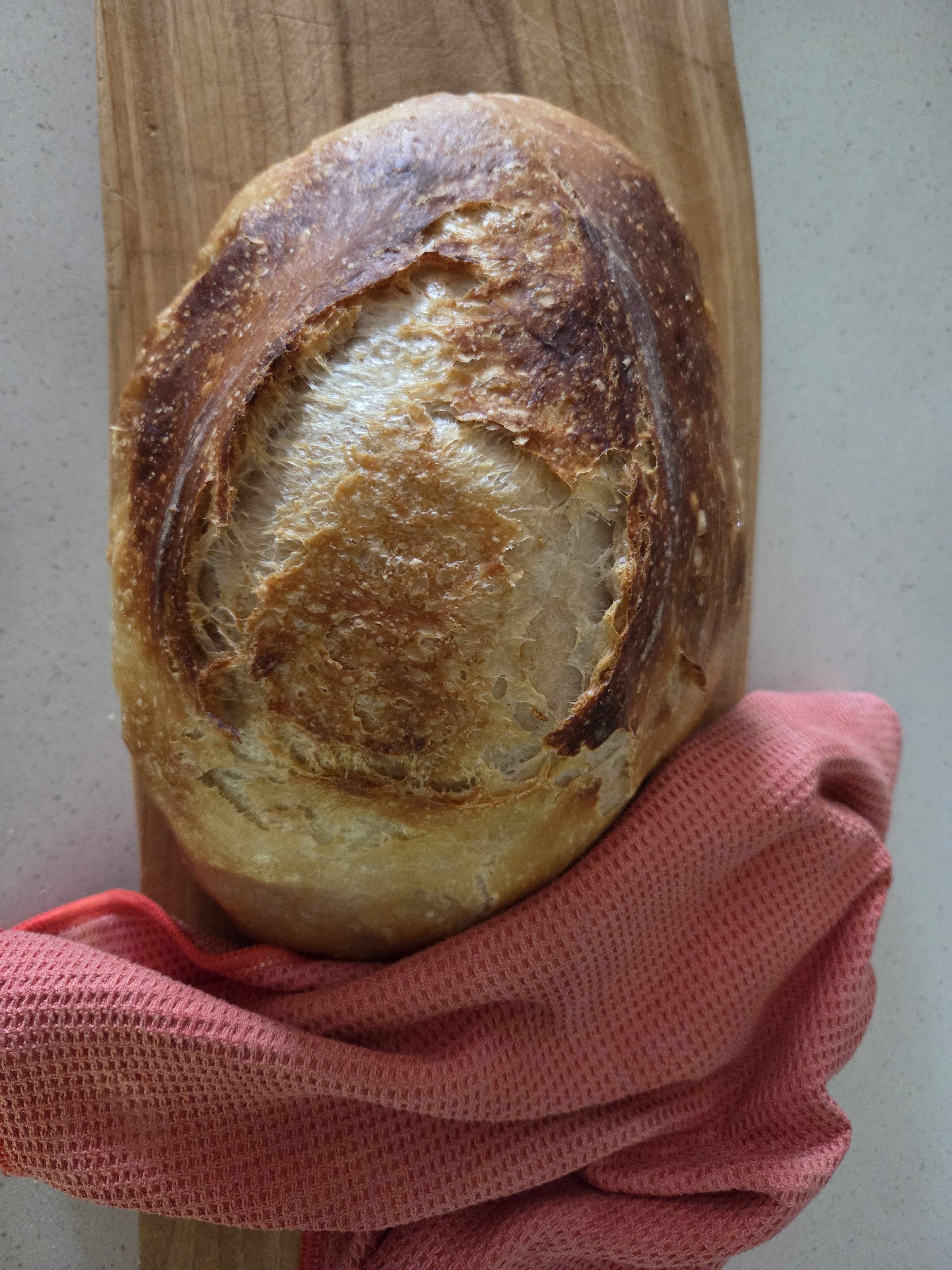
This is easily my favourite bread. It is tangy, with complex flavours and requires you to chew.
This recipe builds flavour over time, but the extra time in the fridge reduces the amount of work you need to do to develop the dough.
Why it works
A number of techniques are employed to build strength and therefore rise in the finished loaf, including:
- A small levain with minimal starter helps build the depth of flavour.
- A 45-minute fermentolyse assists the flour in hydrating fully and prevents the gluten from tightening too early.
- A long cold bulk fermentation takes most of the work involved in building strength in the dough.
A tip: if you are running short on time, cut out the overnight levain but keep the 48 cold bulk ferment.
Detailed guide
Building the levain
Building the levain (preferment) is easy: simply mix the starter, flour and water together in a bowl or tupperware container. Cover and let sit overnight.
Fermentolyse
Where a traditional autolyse mixes only flour and water, this recipe uses a fermentolyse: the levain and ripe starter are added to the flour and water from the beginning all in the same container you made the levain in. I got thoroughly sick of washing bowls and this works just as well.,
Combine all the flour, all but 10g of the water, the levain, and the ripe starter directly in your container — the same one you’ll use for the bulk fermentation. There’s no need for a separate mixing bowl: mix, fold, ferment, and refrigerate all in one vessel, with one lid. Mix until no dry flour remains, then leave to rest for 45 minutes.
Stretch and fold
Stretching and folding develops the gluten and builds the structural integrity of the dough. At 77% hydration with a high levain percentage, this dough is often quite loose. I tend to use some slapping to tighten up the dough with each fold but generally don’t worry too much – the long bulk ferment will help develop the dough after this process.
Beginning 20 minutes after incorporating the salt, perform four sets of stretch and folds spaced 45 minutes apart. With wet hands, stretch the dough upwards and fold it towards yourself. Work around the dough in each cardinal direction — this is one set. At the end of each step ‘throw’ it into the bowl.
The final fold should be a coil fold: lift the dough in the middle and let the ends tuck underneath. This creates vertical tension before the cold bulk fermentation.
Bakers’ percentages and total weights
| Baker’s percentage | Total weights | ||
| White bakers’ flour | 86% | Total starter | 10 g |
| Whole grain flour | 14% | Levain | 190 g |
| Hydration | 77% | Flour | 435 g |
| Salt | 2.5% | Water | 335 g |
| Levain | 25% | Total dough | 770 g |
24 hour sourdough
Equipment
- 1 Dutch oven
- 1 Scraper
- 1 Tupperware / container
- 1 Banneton
- 1 Cooling rack or wire rack
Ingredients
Preferment
- 10 g starter
- 90 g water
- 90 g white flour
Main dough
- 280 g white flour
- 60 g rye flour
- 240 g water
- 11 g salt
Instructions
Fermentolyse
- Mix the active starter, flour and 230 g of water together in your container. Cover and rest for 40 minutes
- Mix the 10 g salt and the remaining 10 g of water together and then mix into the dough.
- Let the dough sit for 15 minutes
Strength building (stretch & fold)
- Perform three sets of stretch and folds, spaced 20-30 minutes apart. These should be cardinal stretch and folds: stretch the dough upwards and fold it toward yourself in each direction (north, south, east, west).
- Perform one final coil fold (4th fold). Lift the dough in the middle and let the ends tuck under. Place this into your container.
Cold bulk fermentation
- Place the dough in the refrigerator for approximately 48 hours.
Shape and bake
- Take the dough out of the fridge, shape it into a tight log or boule, and let it rise on the counter for approximately 1.5 to 2 hours, depending on how the dough rises. Ideally, you will allow it to do this final rise in a banneton to retain shape.
- 240 °C: preheat your oven with the dutch oven inside while the dough rests. When the dough is ready, score the dough, and transfer it to the Dutch oven. Spray with water, and the transfer to the oven.
- Bake with the lid on to trap steam for a golden crust for 30 minutes.
- Remove the lid, and reduce the temperature to 230°C. Bake with the lid off for a further 20 to 30 minutes or until the internal temperature reaches 96 °C.
- Allow the loaf to cool completely on a rack so the crumb can set before slicing, for around 3 hours.



Leave a Reply