
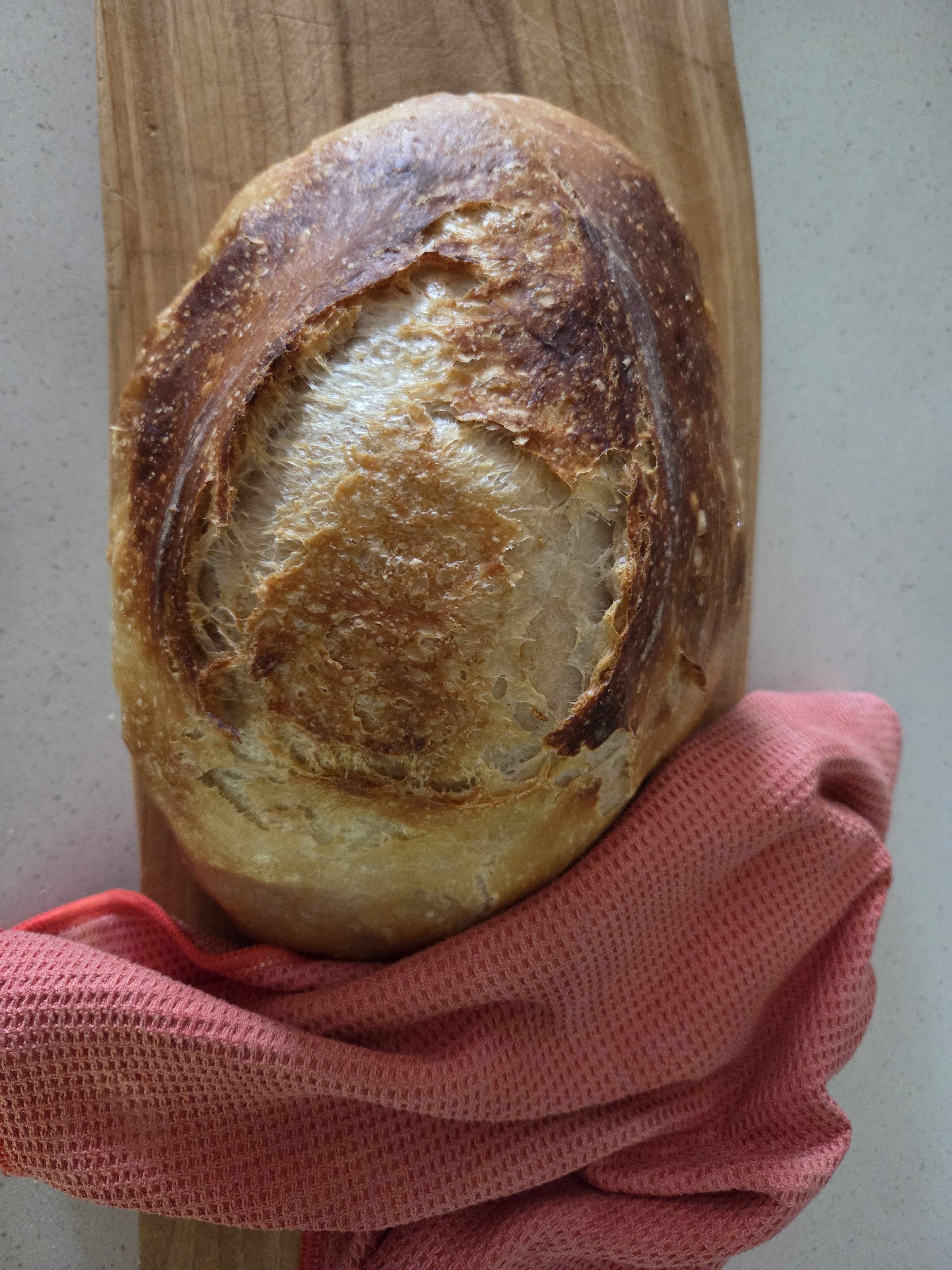
This low hydration sourdough acts as an everyday workhorse. It is easy to make and handle, and its soft uniform interior makes it ideal for sandwiches that hold their contents and toast that doesn’t dribble!
Based on an 18% levain and 64% hydration, a 24 hour cold fermentation develops mild, rounded flavours and a beautiful golden crust. This loaf is easy to slice, shape and handle, making it perfect for those new to baking.
Why it works
A number of techniques are employed to build strength and therefore rise in the finished loaf, including:
- A levain and a mature starter
- An autolyse and delayed salt. Both processes assist in the flour hydrating and prevent the gluten from tightening too early.
- Four stretch and folds.
Adding a mature starter and cold bulk fermenting add complexity in flavour. The cold bulk ferment and low hydration also means that the dough is firmer, which makes it easier to shape and score.
Important bakers’ notes:
Ambient temperatures: The times in this recipe are based on ambient temperatures in the sub-tropics, in summer (28 °C). If you are living in temperatures that are cooler, the dough will take longer to develop. Similarly, if it is hotter, your dough will develop more quickly and you will need to reduce the fermentation times.
Dough ‘feel’ and stretching: During the stretch and folds, pay attention to the dough’s resistance. If the dough feels very tight and resists stretching, it has reached its maximum strength: there is no need for the fourth fold. If it still feels a loose or “shaggy,” complete the fourth fold listed in this recipe.

Detailed guide
Building the levain
A levain, which is a type of preferment, is built by mixing ripe starter with water and flour. A levain allows you to:
- Keep a small starter culture
- Ensure that you have enough yeast and bacteria to develop the dough.
- Higher levain percentages means that you bread has a longer shelf life. A larger culture means that your final bread will have more lactic and acetic acids. Both of these lower the pH of the bread, which helps prevent mould growing. The lactic acid also produces long-chain sugars that soften the bread.
Building the levain is easy: simply mix the starter, flour and water together in a bowl. Cover and let sit overnight.
Autolyse
Autolysing means mixing flour and water together without any yeast (starter or levain) or salt. This allows the water to hydrate the starch and protein in the flour. This process triggers enzyme production that relaxes the gluten, making the dough extensible (stretchy).
In a high-hydration dough, extensibility is the foundation for strength. A stretchy dough will tear less. Additionally, autolysed dough needs less kneading!
Autolysing all the remaining flour and all but 10 g of the water by roughly mixing it together and leaving it to sit for 45 minutes.
Now add the levain and the reserved starter to the dough. Fold both through the dough until it is well combined. The autolysed dough will have become sticky and tense, you will need to stretch and fold the dough to incorporate the levain and starter.
Salt hold-back
Holding back the salt for a short period of time allows the enzymes in the levain and starter to interact with the autolysed flour. This create a more active fermentation and deeper, more complex flavour profile.
Then mix the remaining 10 g of water and 10 g of salt and mix this into the dough by stretching and folding in the water and salt mixture. You will then lit this sit for 15 minutes.
Stretch and fold
Stretching and folding develops the gluten and builds the structural integrity of the dough. Each fold aims to align the gluten strands into a stronger network, which allows the dough to hold the gases produced as it ferments. By folding, we also create layers that trap air, and lead to the large, aerated crumbed of artisan bread.
This is a high-hydration dough, with a high percentage of levain, which means the dough will ferment quickly. The stretch and fold process will be done relatively quickly before we cold ferment the dough.
Perform three stretch and folds 20 minutes apart, starting 20 minutes after you have mixed the salt and water into the dough.
With wet hands, stretch the dough upwards and the fold it towards yourself. This is the first fold (south). Then perform four more stretch and folds in each cardinal direction. This is one set. Perform two more sets of stretch and folds at 20 minute intervals (a total of three).
The final fold will be a coil fold, where you lift the dough in the middle and let the ends tuck under. This provides vertical tension for a cold bulk.
Transfer the dough to an oiled container and place in the fridge for your cold bulk fermentation.
Bakers’ percentages and total weights
| Baker’s percentage | Total weights | ||
| White bakers’ flour | 91% | Total starter | 54 g |
| Whole grain flour | 9% | Levain | 149 g |
| Hydration | 64% | Flour | 500 g |
| Salt | 2.0% | Water | 318 g |
| Levain | 18% | Total dough | 818 |

The anti-leak loaf: a sourdough that holds your mayo
Equipment
- Dutch oven
- Scraper
- Bowl
Ingredients
Levain
- 71 g White Bakers' Flour
- 71 g Water
- 7 g Starter
Main dough
- 355 g White bakers’ flour
- 47 g Whole grain flour
- 220 g Water
- 10 g Salt
- 47 g Ripe sourdough starter
Instructions
Building the levain
Hour 0:00
- Mix 71g flour, 71g water, and 7g ripe starter. Cover and leave at room temperature overnight.
- Refresh your starter at the same time, this will also be used tomorrow.
Main dough
Hour 12:00
- Autolyse (45 mins): Mix 355g white flour, 47g whole grain, and 210 g water (keep 10 g aside). Let it rest for 45 minutes to hydrate the flour.
Hour 12:45
- Add 47g ripe starter and the levain to the autolysed flour and water. Mix until well incorporated and rest for 15 minutes.
Hour 13:00
- Add the 10g salt and the remaining 10 g of water. Knead the dough to distribute the salt.
- Bulk fermentation
Hour 13:00
- Stretch and folds: Perform four sets of stretch and folds, spaced 20 minutes apart (80 minutes total).
Hour: 14:20
- Cold bulk fermentation: Transfer the dough to an oiled container. Seal it and place it in the refrigerator for roughly 24 hours.
- Shaping and building
Hour: 38:00 (ish)
- Shape & rise: Take the dough out of the fridge and shape it into a tight log or boule. Place it into a basket lined with baking paper.
- Preheat: While the dough rises on the counter for 1.5 hours, preheat your oven to 250°C with the Dutch oven inside.
- Score and spray: Just before baking, score (cut) the top of the loaf with a sharp blade. Spray the dough lightly with water.
Bake
Hour: 39:30
- Lid on (30 mins): Carefully place the loaf into the Dutch oven. Bake with the lid on for 30 minutes.
- Lid off (20 mins): Remove the lid and bake for a final 20 minutes: the internal temperature should reach a temperature of 96°C (205°F).
- Place on the counter and allow to cool for around 3 hours for the crumb to set.



Leave a Reply